

Okay, I admit it: I'm biased. Since I read my first book by Tomaso Montanari, " Privati del patrimonio " (as a textbook for my exam in Cultural Heritage Legislation), I've never looked back. I've devoured almost all of his books (in fact, to be honest, I've only read the ones that weren't textbooks, but they always contain a healthy dose of controversy). Later, getting to know him and meeting him at conferences, when he shows up in his leather jacket as a heritage champion, hasn't been unpleasant at all.
But why did I read his volumes, recommend them, and give them as gifts?
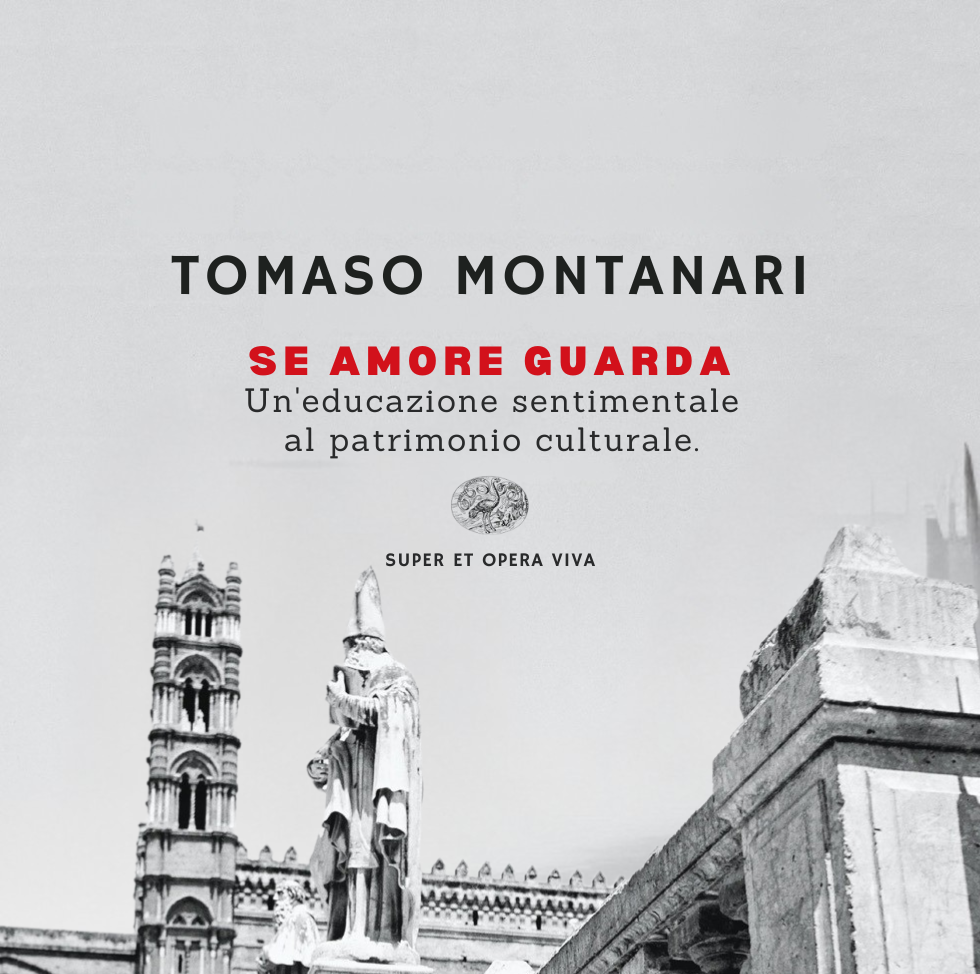
As is well known, alongside his historical and artistic dimension, Montanari pursues a profoundly political discourse, driven by active participation in social life. He raises his voice when it's necessary to defend human rights—just think of " For Gaza" —and, in other cases, he "shields" our past, our memory, and our history, raising concrete and tangible questions about the future of cultural heritage. As museum educators, or anyone who has ever served as a guide, know well, the work isn't simply a list of dates or names, nor is it boring (and boring) oneself with a sequence of facts: rather, it means welcoming, smiling at the curious, putting oneself on the other's level, and finding the right key to convey the vast heritage we have at our disposal, which to many now seems hostile. Montanari reminds us that cultural heritage belongs to everyone, a common good. It is therefore necessary to re-educate people to conceive of themselves as part of a history and tradition deeply rooted in the territory, visible in road constraints, buildings, and the landscape, and not only within museums and churches. Very often, those who study art remain anchored to a network of abstract, aesthetic, and ethical knowledge, which leads to the idealization of the object, but which is difficult to apply outside of the academic sphere. Instead, in " Instructions for the Use of the Future," Montanari questions where and how society and politics play their part, thus managing to situate the artifacts of the past in the concreteness of our present. In the volume Se amore guarda , first published in 2023, the author opens with a fundamental question: "What are we really talking about when we talk about cultural heritage?" Of course, we can reel off definitions that involve protection and valorization—and rightly so—but what Montanari aspires to is to reemphasize "the liberating power with which heritage opens our eyes and our hearts to another dimension." Matter itself provides concrete confirmation that this "other time" actually existed. We must be able to "make our contemporaries feel that on the cobblestones of the streets, on the asphalt of cars, the echo of countless footsteps resounds: a multitude of lives, stories, meanings (...)." Along these lines, Montanari reflects on the coexistence of time and how we can learn to read it. He continues with the chapter dedicated to "living bodies," explaining how the experience of heritage is not merely erudite or intellectual, but involves all the senses: from the eye that glimpses the epigraphs in a church, to the footsteps that walk down the nave, to the sense of smell that detects incense. These are, in effect, total experiences. The author then traces the birth of the modern concept of conservation, first formulated in Raphael's famous letter of 1519: the problem of how to give voice to a now lost community, the constant conflict between those who wish to save and those who wish to destroy—especially when it comes to "difficult heritages"—and the issue of identities, which can also translate into elective affinities dictated by individual sensibilities. Finally, Montanari asks how to make all this available to humanity, to allow us to connect with what David Grossman calls the "force of humanity in humanity." This is how the author teaches us to connect with heritage and, if we wish, emerge more human from it. When we understand that cultural heritage surrounds us, engulfs us, and flows through us almost by osmosis—and that it is not an abstract entity to be studied only in textbooks—then we will be able to recognize, on the whitewashed walls of museums, a traditio , a passing from hand to hand that binds generations, and begin to truly feel part of something larger than ourselves. I highly recommend reading Montanari: from " Closed Churches" to " Against Exhibitions," from " What's Michelangelo for?" to " The Right Statues," from " Starting from the ABC" to " Heritage and Civil Conscience." His books allow us to acquire a critical but also profoundly aware and loving perspective, capable of opening a gateway to other times and places and making us all feel a little more involved. Cultural heritage is a collective property—of each and every one—and a fundamental right, at the very foundation of our being a civilization.


